Olympic Champion Sara Simeoni Talks about Gender Barriers in Sport and Medicine
Culture, Opportunities and Resources
Downloads
Keywords:
gender-based medicine, women’s sport, health psychology, clinical nutrition, high jumpAbstract
An overview of the relationship between elite athletes’ sport activity and medicine was presented during a conference with guest speaker Mrs. Sara Simeoni, Italian Olympic Games high jump champion (one gold medal, in Moscow, and silver medals in Montreal and Los Angeles). She has had a particularly prolonged career for this type of sport activity, and her endorsement and support, since she is a recognized icon of sport excellence, is very important. This is particularly true in relevant and sensitive topics such as gender inequalities, physical exercise and sport ethics. During the conference, the relationship between nutrition, physical activity and health, in both medicine and social life, were also covered. In reality, we still find that the cultural, economic, societal and political barriers are present and, currently, in some regards, they are even stronger than in the past. The interplay between evidence-based medicine, elite athletes’ training, physical fitness practice and physical exercise intervention in health and disease is still being developed. Defining methods and clarifying multidimensional outcomes should, as much as possible, be pursued, and sustainable strategies and tools should be discussed.
References
(1) Trovato GM. Behavior, nutrition and lifestyle in a comprehensive health and disease paradigm: skills and knowledge for a predictive, preventive and personalized medicine. EPMA Journal. 2012 Mar 22;3(1).
(2) Trovato GM. Sustainable medical research by effective and comprehensive medical skills: overcoming the frontiers by predictive, preventive and personalized medicine. EPMA Journal. 2014 Aug 27;5(1).
(3) Trovato FM, Catalano D, Martines GF, Pace P, Trovato GM. Mediterranean diet and non-alcoholic fatty liver disease. Clinical Nutrition. 2015 Feb;34(1):86–8.
(4) Trovato FM, Martines GF, Brischetto D, Catalano D, Musumeci G, Trovato GM. Fatty liver disease and lifestyle in youngsters: diet, food intake frequency, exercise, sleep shortage and fashion. Liver International. 2015 Sep 28;36(3):427–33.
(5) Catalano D, Trovato GM, Pace P, Martines GF, Trovato FM. Mediterranean diet and physical activity: An intervention study. Does olive oil exercise the body through the mind? International Journal of Cardiology. 2013 Oct;168(4):4408–9.
(6) Trovato GM, Catalano D, Trovato FM. The challenge of obesity: Can we look to the moon instead of the finger? J. Am. Coll. Cardiol. 2013; 62, 1036.
(7) Trovato, G.M, Pace, P, Cangemi E, Martines GF, Trovato FM, Catalano D. Gender, lifestyles, illness perception and stress in stable atrial fibrillation. Clin. Ter. 2012; 163, 281–286.
(8) Trovato GM, Catalano D, Sperandeo M. Top or Flop: The need to improve knowledge and skills achieved by Ultrasound Medical Curricula. Acad. Med. 2015; 90, 839–840.
(9) Trovato FM, Musumeci G. Lung ultrasound: The need of an adequate training for the next generation of internists. Neth. J. Med. 2015; 73, 305.
(10) Trovato FM, Catalano D, Musumeci G, Trovato GM. 4Ps medicine of the fatty liver: the research model of predictive, preventive, personalized and participatory medicine—recommendations for facing obesity, fatty liver and fibrosis epidemics. EPMA Journal. 2014 Dec;5(1).
(11) Braun B, Horton T. Endocrine Regulation of Exercise Substrate Utilization in Women Compared to Men. Exercise and Sport Sciences Reviews. 2001 Oct;29(4):149–54.
(12) Hansen M, Kjaer M. Influence of Sex and Estrogen on Musculotendinous Protein Turnover at Rest and After Exercise. Exercise and Sport Sciences Reviews. 2014 Oct;42(4):183–92.
(13) Howe S, Hand T, Manore M. Exercise-Trained Men and Women: Role of Exercise and Diet on Appetite and Energy Intake. Nutrients. 2014 Nov 10;6(11):4935–60.
(14) Trovato GM, Catalano D, Martines GF, Pirri C, Trovato FM. Western Dietary Pattern and Sedentary Life: Independent Effects of Diet and Physical Exercise Intensity on NAFLD. American Journal of Gastroenterology. 2013 Dec;108(12):1932–3.
(15) Westenhoefer J. Age and gender dependent profile of food choice. Forum Nutr. 2005; 57, 44–51.
(16) Rolls BJ, Fedoroff IC, Guthrie JF. Gender differences in eating behavior and body weight regulation. Health Psychology. 1991;10(2):133–42.
(17) Trovato GM. Mediterranean Diet—The Myth and the Truth; L&L Press: Dutham, NC, USA, 2009; pp. 1–337.
(18) Trovato GM, Catalano D, Martines GF, Pace P, Trovato FM. Mediterranean diet: Relationship with anxiety and depression. Annals of Neurology. 2014 Apr;75(4):613–3.
(19) Trovato GM, Martines GF, Trovato FM, Catalano D. Re: “Relation of the Traditional Mediterranean Diet to Cerebrovascular Disease in a Mediterranean Population.” American Journal of Epidemiology. 2013 Jun 20;178(4):661–1.
(20) Høeg LD, Sjøberg KA, Jeppesen J, Jensen TE, Frøsig C, Birk JB, et al. Lipid-Induced Insulin Resistance Affects Women Less Than Men and Is Not Accompanied by Inflammation or Impaired Proximal Insulin Signaling. Diabetes. 2010 Oct 18;60(1):64–73.
(21) Lundsgaard AM, Kiens B. Gender Differences in Skeletal Muscle Substrate Metabolism – Molecular Mechanisms and Insulin Sensitivity. Frontiers in Endocrinology. 2014 Nov 13;5(13).
(22) Shapira N. Women’s higher health risks in the obesogenic environment: a gender nutrition approach to metabolic dimorphism with predictive, preventive, and personalised medicine. EPMA Journal. 2013 Jan 12;4(1).
(23) Loptson K, Muhajarine N, Ridalls T, Muhajarine N, Chad K, Neudorf C, et al. Walkable for Whom? Examining the Role of the Built Environment on the Neighbourhood-based Physical Activity of Children. Canadian Journal of Public Health. 2012 Nov;103(S3):S29–34.
(24) Esliger DW, Sherar LB, Muhajarine N. Smart Cities, Healthy Kids: The Association Between Neighbourhood Design and Children’s Physical Activity and Time Spent Sedentary. Canadian Journal of Public Health. 2012 Nov;103(S3):S22–8.
(25) Trovato G, Brischetto D, Martines GF. Teens’ obesity, noise and sleep deprivation: A perverse liaison. Let’s move beyond “movida.” Obesity. 2014 Feb 18;22(5):1209–9.
(26) Trovato G, Brischetto D, Pace P, Fabio Martines G. Perceived Body Weight Status of Youngsters Interferes With Headache in Obese and Non-Obese Subjects. Headache: The Journal of Head and Face Pain. 2014 Jun;54(6):1062–3.
(27) Trovato G, Pace P, Martines GF, Brischetto D. Mala-movida: Late bed-timing and wake-up induce malnutrition and underweight in youngsters. Chronobiology International. 2014 Jun 25;31(8):945–6.
(28) Dapena J, Chung CS. Vertical and radial motions of the body during the take-off phase of high jumping. Medicine & Science in Sports & Exercise. 1988 Jun;20(3):290–302.
(29) Marina M, Jemni M, Rodríguez F. Jumping performance profile of male and female gymnasts. J. Sports Med. Phys. Fit. 2013; 53, 378–386.
(30) Schmitt H, Dubljanin E, Schneider S, Schiltenwolf M. Radiographic Changes in the Lumbar Spine in Former Elite Athletes. Spine. 2004 Nov;29(22):2554–9.
(31) Olsson CJ, Jonsson B, Nyberg L. Internal imagery training in active high jumpers. Scandinavian Journal of Psychology. 2008 Apr;49(2):133–40.
(32) Lees A, Rojas J, Cepero M, Soto V, Gutierrez M. How the free limbs are used by elite high jumpers in generating vertical velocity. Ergonomics. 2000 Oct;43(10):1622–36.
(33) Massimino A, Trovato G, Monte I, di Fazzio S, Modica G. Vectorcardiographic changes during exercise in normal subjects. Cardiologia 1982; 27, 463–476.
(34) Trovato GM, Massimino A, Mammana S, D’Urso V, Vancheri F, Modica G. Exercise echocardiography in normal subjects. Boll. Soc. Ital. Cardiol. 1981; 26, 2209–2223.
(35) Holloway JB, Baechle TR. Strength Training for Female Athletes. Sports Medicine. 1990 Apr;9(4):216–28.
(36) Carbon R. ABC of Sports Medicine: Female Athletes. BMJ. 1994 Jul 23;309(6949):254–8.
(37) Lewis DA, Kamon E, Hodgson JL. Physiological differences between genders. Implications for sports conditioning. Sports medicine (Auckland, NZ) [Internet]. 1986;3(5):357–69. Available from: https://www.ncbi.nlm.nih.gov/pubmed/3529284
(38) Zamparo P, Minetti AE, di Prampero PE. Interplay among the changes of muscle strength, cross-sectional area and maximal explosive power: theory and facts. European Journal of Applied Physiology. 2002 Dec 1;88(3):193–202.
(39) Miyaguchi K, Demura S. Specific Factors That Influence Deciding the Takeoff Leg during Jumping Movements. Journal of Strength and Conditioning Research. 2010 Sep;24(9):2516–22.
________________________________________
This article has been adapted and translated into Portuguese by the editors of OLYMPIKA MAGAZINE for republication, in accordance with the journal's submission guidelines. Original version available at: https://www.mdpi.com/2411-5142/1/3/303. ORIGINAL AND VERSION LICENSE: https://creativecommons.org/licenses/by/4.0/.
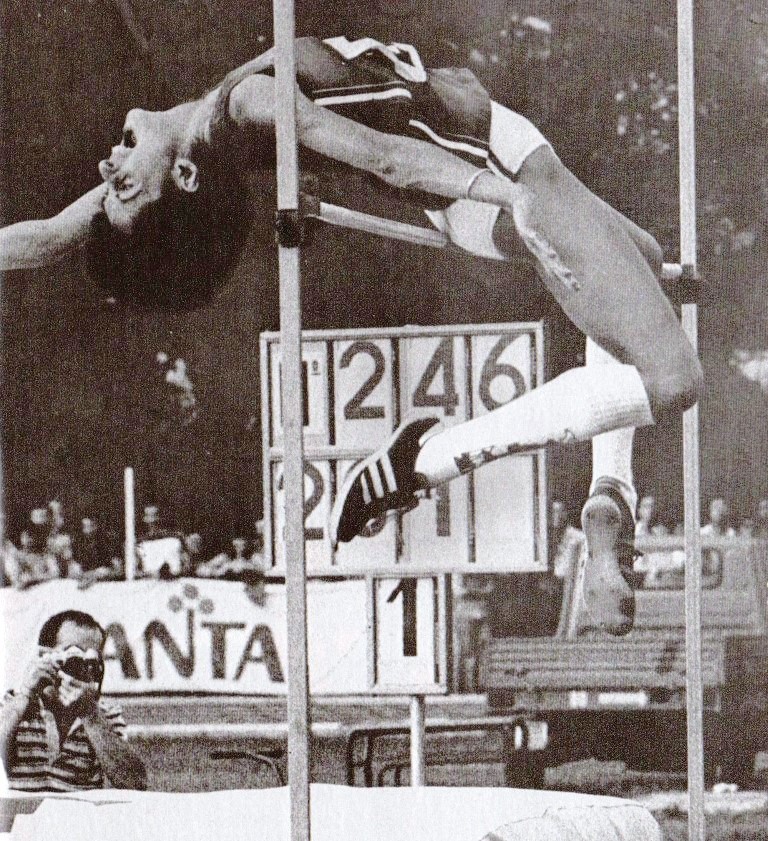
IMAGEM MERAMENTE ILUSTRATIVA. Sara Simeoni estabelece o recorde mundial de salto em altura com 2,01 m (Brescia, 4 de agosto de 1978)/ Licença: https://it.wikipedia.org/wiki/File:Sara_Simeoni_record_201.jpg
Published
How to Cite / Vancouver
Issue
Section
ARK
License
Copyright (c) 2026 Sara Simeoni , Daniela Catalano

This work is licensed under a Creative Commons Attribution 4.0 International License.