A campeã olímpica Sara Simeoni fala sobre as barreiras de gênero no esporte e na medicina
Cultura, oportunidades e recursos
Downloads
Palavras-chave:
Medicina Com Perspectiva De Gênero, Esporte Feminino, Psicologia, Nutrição Clínica, Salto Em AlturaResumo
Uma visão geral da relação entre a atividade esportiva de atletas de elite e a medicina foi apresentada durante uma conferência com a palestrante convidada, Sra. Sara Simeoni, campeã italiana de salto em altura nos Jogos Olímpicos (uma medalha de ouro em Moscou e medalhas de prata em Montreal e Los Angeles). Ela possui uma carreira particularmente longa nesse tipo de atividade esportiva, e seu endosso e apoio, por ser um ícone reconhecido da excelência esportiva, são de grande importância. Isso se torna ainda mais relevante em temas sensíveis como desigualdades de gênero, exercício físico e ética no esporte. Durante a conferência, também foi abordada a relação entre nutrição, atividade física e saúde, tanto na medicina quanto na vida social. Na realidade, ainda encontramos barreiras culturais, econômicas, sociais e políticas presentes e, atualmente, em alguns aspectos, ainda mais fortes do que no passado. A interação entre medicina baseada em evidências, treinamento de atletas de elite, prática de condicionamento físico e intervenção com exercícios físicos na saúde e na doença ainda está em desenvolvimento. A definição de métodos e a clarificação de resultados multidimensionais devem ser priorizadas, e estratégias e ferramentas sustentáveis devem ser discutidas.
Referências
(1) Trovato GM. Behavior, nutrition and lifestyle in a comprehensive health and disease paradigm: skills and knowledge for a predictive, preventive and personalized medicine. EPMA Journal. 2012 Mar 22;3(1).
(2) Trovato GM. Sustainable medical research by effective and comprehensive medical skills: overcoming the frontiers by predictive, preventive and personalized medicine. EPMA Journal. 2014 Aug 27;5(1).
(3) Trovato FM, Catalano D, Martines GF, Pace P, Trovato GM. Mediterranean diet and non-alcoholic fatty liver disease. Clinical Nutrition. 2015 Feb;34(1):86–8.
(4) Trovato FM, Martines GF, Brischetto D, Catalano D, Musumeci G, Trovato GM. Fatty liver disease and lifestyle in youngsters: diet, food intake frequency, exercise, sleep shortage and fashion. Liver International. 2015 Sep 28;36(3):427–33.
(5) Catalano D, Trovato GM, Pace P, Martines GF, Trovato FM. Mediterranean diet and physical activity: An intervention study. Does olive oil exercise the body through the mind? International Journal of Cardiology. 2013 Oct;168(4):4408–9.
(6) Trovato GM, Catalano D, Trovato FM. The challenge of obesity: Can we look to the moon instead of the finger? J. Am. Coll. Cardiol. 2013; 62, 1036.
(7) Trovato, G.M, Pace, P, Cangemi E, Martines GF, Trovato FM, Catalano D. Gender, lifestyles, illness perception and stress in stable atrial fibrillation. Clin. Ter. 2012; 163, 281–286.
(8) Trovato GM, Catalano D, Sperandeo M. Top or Flop: The need to improve knowledge and skills achieved by Ultrasound Medical Curricula. Acad. Med. 2015; 90, 839–840.
(9) Trovato FM, Musumeci G. Lung ultrasound: The need of an adequate training for the next generation of internists. Neth. J. Med. 2015; 73, 305.
(10) Trovato FM, Catalano D, Musumeci G, Trovato GM. 4Ps medicine of the fatty liver: the research model of predictive, preventive, personalized and participatory medicine—recommendations for facing obesity, fatty liver and fibrosis epidemics. EPMA Journal. 2014 Dec;5(1).
(11) Braun B, Horton T. Endocrine Regulation of Exercise Substrate Utilization in Women Compared to Men. Exercise and Sport Sciences Reviews. 2001 Oct;29(4):149–54.
(12) Hansen M, Kjaer M. Influence of Sex and Estrogen on Musculotendinous Protein Turnover at Rest and After Exercise. Exercise and Sport Sciences Reviews. 2014 Oct;42(4):183–92.
(13) Howe S, Hand T, Manore M. Exercise-Trained Men and Women: Role of Exercise and Diet on Appetite and Energy Intake. Nutrients. 2014 Nov 10;6(11):4935–60.
(14) Trovato GM, Catalano D, Martines GF, Pirri C, Trovato FM. Western Dietary Pattern and Sedentary Life: Independent Effects of Diet and Physical Exercise Intensity on NAFLD. American Journal of Gastroenterology. 2013 Dec;108(12):1932–3.
(15) Westenhoefer J. Age and gender dependent profile of food choice. Forum Nutr. 2005; 57, 44–51.
(16) Rolls BJ, Fedoroff IC, Guthrie JF. Gender differences in eating behavior and body weight regulation. Health Psychology. 1991;10(2):133–42.
(17) Trovato GM. Mediterranean Diet—The Myth and the Truth; L&L Press: Dutham, NC, USA, 2009; pp. 1–337.
(18) Trovato GM, Catalano D, Martines GF, Pace P, Trovato FM. Mediterranean diet: Relationship with anxiety and depression. Annals of Neurology. 2014 Apr;75(4):613–3.
(19) Trovato GM, Martines GF, Trovato FM, Catalano D. Re: “Relation of the Traditional Mediterranean Diet to Cerebrovascular Disease in a Mediterranean Population.” American Journal of Epidemiology. 2013 Jun 20;178(4):661–1.
(20) Høeg LD, Sjøberg KA, Jeppesen J, Jensen TE, Frøsig C, Birk JB, et al. Lipid-Induced Insulin Resistance Affects Women Less Than Men and Is Not Accompanied by Inflammation or Impaired Proximal Insulin Signaling. Diabetes. 2010 Oct 18;60(1):64–73.
(21) Lundsgaard AM, Kiens B. Gender Differences in Skeletal Muscle Substrate Metabolism – Molecular Mechanisms and Insulin Sensitivity. Frontiers in Endocrinology. 2014 Nov 13;5(13).
(22) Shapira N. Women’s higher health risks in the obesogenic environment: a gender nutrition approach to metabolic dimorphism with predictive, preventive, and personalised medicine. EPMA Journal. 2013 Jan 12;4(1).
(23) Loptson K, Muhajarine N, Ridalls T, Muhajarine N, Chad K, Neudorf C, et al. Walkable for Whom? Examining the Role of the Built Environment on the Neighbourhood-based Physical Activity of Children. Canadian Journal of Public Health. 2012 Nov;103(S3):S29–34.
(24) Esliger DW, Sherar LB, Muhajarine N. Smart Cities, Healthy Kids: The Association Between Neighbourhood Design and Children’s Physical Activity and Time Spent Sedentary. Canadian Journal of Public Health. 2012 Nov;103(S3):S22–8.
(25) Trovato G, Brischetto D, Martines GF. Teens’ obesity, noise and sleep deprivation: A perverse liaison. Let’s move beyond “movida.” Obesity. 2014 Feb 18;22(5):1209–9.
(26) Trovato G, Brischetto D, Pace P, Fabio Martines G. Perceived Body Weight Status of Youngsters Interferes With Headache in Obese and Non-Obese Subjects. Headache: The Journal of Head and Face Pain. 2014 Jun;54(6):1062–3.
(27) Trovato G, Pace P, Martines GF, Brischetto D. Mala-movida: Late bed-timing and wake-up induce malnutrition and underweight in youngsters. Chronobiology International. 2014 Jun 25;31(8):945–6.
(28) Dapena J, Chung CS. Vertical and radial motions of the body during the take-off phase of high jumping. Medicine & Science in Sports & Exercise. 1988 Jun;20(3):290–302.
(29) Marina M, Jemni M, Rodríguez F. Jumping performance profile of male and female gymnasts. J. Sports Med. Phys. Fit. 2013; 53, 378–386.
(30) Schmitt H, Dubljanin E, Schneider S, Schiltenwolf M. Radiographic Changes in the Lumbar Spine in Former Elite Athletes. Spine. 2004 Nov;29(22):2554–9.
(31) Olsson CJ, Jonsson B, Nyberg L. Internal imagery training in active high jumpers. Scandinavian Journal of Psychology. 2008 Apr;49(2):133–40.
(32) Lees A, Rojas J, Cepero M, Soto V, Gutierrez M. How the free limbs are used by elite high jumpers in generating vertical velocity. Ergonomics. 2000 Oct;43(10):1622–36.
(33) Massimino A, Trovato G, Monte I, di Fazzio S, Modica G. Vectorcardiographic changes during exercise in normal subjects. Cardiologia 1982; 27, 463–476.
(34) Trovato GM, Massimino A, Mammana S, D’Urso V, Vancheri F, Modica G. Exercise echocardiography in normal subjects. Boll. Soc. Ital. Cardiol. 1981; 26, 2209–2223.
(35) Holloway JB, Baechle TR. Strength Training for Female Athletes. Sports Medicine. 1990 Apr;9(4):216–28.
(36) Carbon R. ABC of Sports Medicine: Female Athletes. BMJ. 1994 Jul 23;309(6949):254–8.
(37) Lewis DA, Kamon E, Hodgson JL. Physiological differences between genders. Implications for sports conditioning. Sports medicine (Auckland, NZ) [Internet]. 1986;3(5):357–69. Available from: https://www.ncbi.nlm.nih.gov/pubmed/3529284
(38) Zamparo P, Minetti AE, di Prampero PE. Interplay among the changes of muscle strength, cross-sectional area and maximal explosive power: theory and facts. European Journal of Applied Physiology. 2002 Dec 1;88(3):193–202.
(39) Miyaguchi K, Demura S. Specific Factors That Influence Deciding the Takeoff Leg during Jumping Movements. Journal of Strength and Conditioning Research. 2010 Sep;24(9):2516–22.
________________________________________
This article has been adapted and translated into Portuguese by the editors of OLYMPIKA MAGAZINE for republication, in accordance with the journal's submission guidelines. Original version available at: https://www.mdpi.com/2411-5142/1/3/303. ORIGINAL AND VERSION LICENSE: https://creativecommons.org/licenses/by/4.0/.
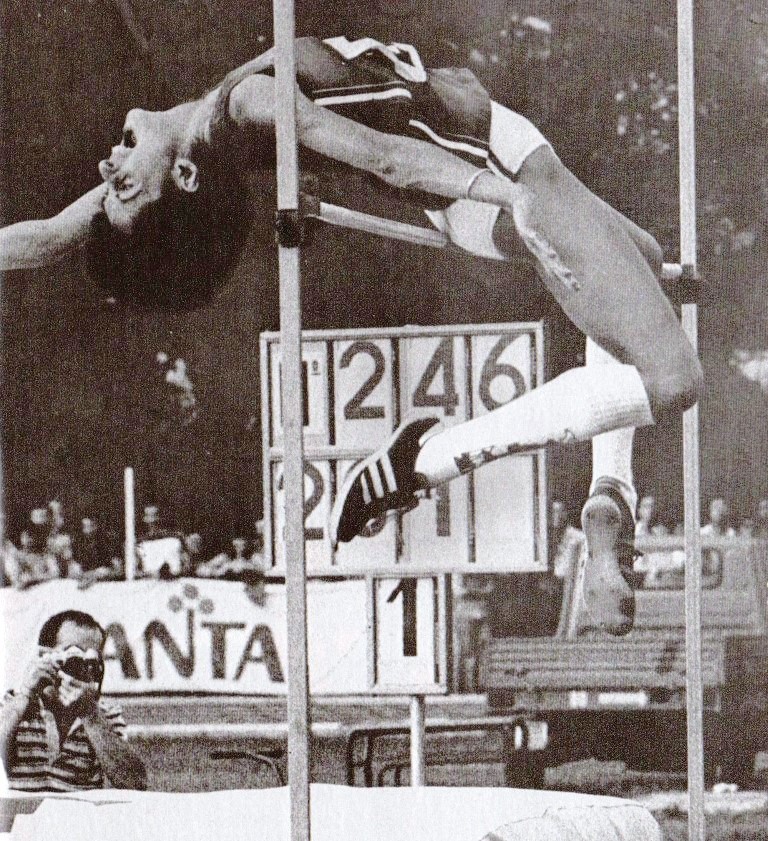
IMAGEM MERAMENTE ILUSTRATIVA. Sara Simeoni estabelece o recorde mundial de salto em altura com 2,01 m (Brescia, 4 de agosto de 1978)/ Licença: https://it.wikipedia.org/wiki/File:Sara_Simeoni_record_201.jpg
Publicado
Como Citar / Vancouver
Edição
Secção
ARK
Licença
Direitos de Autor (c) 2026 Sara Simeoni , Daniela Catalano

Este trabalho encontra-se publicado com a Licença Internacional Creative Commons Atribuição 4.0.