La prolongada cuestión de la movilidad en los Juegos Olímpicos
De las ciudades anfitrionas a las regiones anfitrionas en el estudio de caso en curso de Milano-Cortina 2026
Palabras clave:
Agenda Olímpica 2020, Juegos Olímpicos, Planificación de megaeventos, Ciudad Olímpica, Transporte, Movilidad, Sostenibilidad, Milano-Cortina 2026Resumen
Debido a la oposición pública a la insostenibilidad de albergar los Juegos Olímpicos, el Comité Olímpico Internacional adoptó la Agenda Olímpica 2020 para ajustar los requisitos del evento y abordar las preocupaciones de sostenibilidad de la sociedad moderna. Desde su implementación, la Agenda ha impulsado cambios significativos en la planificación y organización de los Juegos Olímpicos, incluyendo la posibilidad de regiones anfitrionas. Esto permite la expansión de las instalaciones olímpicas a territorios más amplios, lo que, en teoría, facilita la alineación de los requisitos del evento con las necesidades de las áreas urbanas contemporáneas en rápido crecimiento. Sin embargo, cuanto mayor sea el territorio anfitrión, más compleja se vuelve la planificación de la movilidad, ya que aún deben satisfacerse las necesidades de transporte de los participantes y las poblaciones anfitrionas aún esperan beneficiarse de las inversiones realizadas. El objetivo de este artículo es identificar y analizar los nuevos desafíos que estas modificaciones plantean a la planificación de la movilidad en megaeventos. En primer lugar, a partir de la literatura académica de estudios de caso de ciudades olímpicas anteriores, se propone un marco teórico para sistematizar el problema de la movilidad en los Juegos Olímpicos, con miras a su posterior validación e identificando las dimensiones de los respectivos marcos de conocimiento. En segundo lugar, se describe la planificación de la movilidad para el caso de estudio de la primera región olímpica de la historia: los Juegos Olímpicos de Invierno Milano-Cortina 2026. A partir de este estudio de caso, la estructura propuesta se extrapola a otros casos de regiones olímpicas para identificar posibles cambios en el paradigma de la planificación de la movilidad cuando aumenta la escala espacial de las ciudades sede de los Juegos Olímpicos. Las conclusiones indican que, si se aborda adecuadamente, la insostenibilidad puede mitigarse en las regiones olímpicas, pero los planificadores de megaeventos deberán considerar los nuevos problemas que afectan a las comunidades anfitrionas y a los participantes.
PID
— ARK: ark:/40019/oly.v4i4.32.g43
Citas
(1) Bovy P. Athens 2004 Olympic Games Transport. Str. Verkehr 2004; 7–8, 45–48.
(2) Bovy P. Solving outstanding mega-event transport challenges: The Olympic experience. Public Transp. Int. 2006; 6, 32–34.
(3) Kassens-Noor E. Sustaining the Momentum. Transp. Res. Rec. J. Transp. Res. Board 2010; 2187, 106–113.
(4) IOC. Olympic Agenda 2020—Olympic Games: The New Norm; IOC: Lausanne, Switzerland, 2018.
(5) Flyvbjerg B, Budzier A, Lunn D. Regression to the Tail: Why the Olympics Blow Up. SSRN Electronic Journal. 2020;53(2).
(6) Kassens-Noor E. Transport Legacy of the Olympic Games, 1992–2012. Journal of Urban Affairs. 2013 Oct;35(4):393–416.
(7) Essex S, Chalkley B. Mega‐sporting events in urban and regional policy: a history of the Winter Olympics. Planning Perspectives. 2004 Apr;19(2):201–4.
(8) Liao H, Pitts A. A brief historical review of Olympic urbanization. The International Journal of the History of Sport. 2006 Nov;23(7):1232–52.
(9) Gold JR, Gold MM. Olympic cities : city agendas, planning and the world’s games, 1896-2016. London ; New York: Routledge; 2011.
(10) Robbins D, Dickinson J, Calver S. Planning transport for special events: a conceptual framework and future agenda for research. International Journal of Tourism Research. 2007;9(5):303–14.
(11) Currie G, Delbosc A. Assessing Travel Demand Management for the Summer Olympic Games. Transportation Research Record: Journal of the Transportation Research Board. 2011 Jan;2245(1):36–48.
(12) Bovy P. No Transport White Elephants. Siemens ITS Mag. Intell. Traffic Syst. 2010; 2, 16–18.
(13) Lopes dos Santos G, Gonçalves J. The Olympic Effect in Strategic planning: Insights from Candidate Cities. Planning Perspectives. 2021 Nov 22;37(4):1–25.
(14) Lopes dos Santos G, Gonçalves J, Condessa B, Nunes da Silva F, Delaplace M. Olympic Charter Evolution Shaped by Urban Strategies and Stakeholder’s Governance: From Pierre de Coubertin to the Olympic Agenda 2020. The International Journal of the History of Sport. 2021 Mar 24;38(5):545–68.
(15) IOC. Olympic Charter; IOC: Lausanne, Switzerland, 2019.
(16) Banister D. Cities, mobility and climate change. Journal of Transport Geography. 2011 Nov;19(6):1538–46.
(17) IOC. IOC Legacy Strategic Approach—Moving Forward; IOC: Lausanne, Switzerland, 2017.
(18) Mao B. Analysis on Transport Policies of Post-Olympic Times of Beijing. Journal of Transportation Systems Engineering and Information Technology. 2008 Dec;8(6):138–45.
(19) Zhou Y, Wu Y, Yang L, Fu L, He K, Wang S, et al. The impact of transportation control measures on emission reductions during the 2008 Olympic Games in Beijing, China. Atmospheric Environment. 2010 Jan;44(3):285–93.
(20) Currie G, Shalaby A. Synthesis of Transport Planning Approaches for the World’s Largest Events. Transp. Rev. 2012; 32, 113–136.
(21) Bovy P. Beijing 2008 Olympic Games success: Massive public transport developments and major road traffic reduction. Public Transp. Int. 2009; 58, 52–55.
(22) Kassens-Noor E. Transportation planning and policy in the pursuit of mega-events: Boston’s 2024 Olympic bid. Transport Policy. 2019 Feb;74:239–45.
(23) Lauermann J. “The city” as developmental justification: claimsmaking on the urban through strategic planning. Urban Geography. 2015 Jul;37(1):77–95.
(24) IOC. The New Approach to Electing Olympic and Paralympic Hosts. Available online: https://olympics.com/ioc/future-host-election (accessed on 3 September 2021).
(25) IOC. Host City Contract—Operational Requirements; IOC: Lausanne, Switzerland, 2018.
(26) Kassens-Noor E. Transportation Planning for Mega-Events: A Model of Urban Change. Ph.D. Thesis, Massachusetts Institute of Technology, Cambridge, MA, USA, 2009.
(27) Preuss H. Event legacy framework and measurement. International Journal of Sport Policy and Politics. 2018 Jul 24;11(1):103–18.
(28) Ieromonachou P, Warren J, Potter S. The Olympic transport legacy. Town Ctry. Plan. 2010; 79, 331–336.
(29) Preuss, H. The Conceptualization and Measurement of Mega Sport Event Legacies. J. Sport Tour. 2007, 12, 207–228.
(30) Girginov V. Governance of the London 2012 Olympic Games legacy. International Review for the Sociology of Sport. 2011 Jun 27;47(5):543–58.
(31) Karlaftis MG, Kepaptsoglou K, Stathopoulos A, Starra A. Planning Public Transport Networks for the 2004 Summer Olympics with Decision Support Systems. Transportation Research Record: Journal of the Transportation Research Board. 2004 Jan;1887(1):71–82.
(32) Delaplace M. The Relationship between Olympic Games and Tourism: Why Such Heterogeneity? Towards a Place-Based Approach. In Hosting the Olympic Games: Uncertainty, Debates and Controversy, 1st ed, Delaplace, M., Schut, P.O., Eds, Routledge: Oxon, UK, 2020; Part II, Chapter 7; pp. 127–148.
(33) Bovy P, Potier F, Liaudat C. Les Grandes Manifestations: Plannification, Gestion des Mobilités et Impacts. Recherche DRAST Nº00 MT30/RATP, Programme National de Recherche et d’Innovation dans les Transports Terrestres; France. 2003. Available online: http://isidoredd.documentation.developpement-durable.gouv.fr/documents/CETTEXST005049/CETTEXST005049.pdf (accessed on 2 January 2022).
(34) Kassens-Noor E. Managing Transport at the Football World Cup. In Managing the Football World Cup, 1st ed, Frawley, S., Adair, D., Eds, Palgrave Macmillan: Basingstoke, UK, 2014; Chapter 9; pp. 149–174.
(35) Frantzeskakis JM, Frantzeskakis MJ. Athens 2004 Olympic Games: Transportation Planning, Simulation and Traffic Management. ITE J. 2006; 76, 26–32.
(36) Parkes SD, Jopson A, Marsden G. Understanding travel behaviour change during mega-events: Lessons from the London 2012 Games. Transportation Research Part A: Policy and Practice [Internet]. 2016 Oct 1;92:104–19. Available from: https://www.sciencedirect.com/science/article/abs/pii/S096585641630101X
(37) Bovy P. Public transport international. 2004 Mar 1;53(2).
(38) Hensher DA, Brewer AM. Going for gold at the Sydney Olympics: How did transport perform? Transport Reviews. 2002 Jan;22(4):381–99.
(39) Chappelet JL. From Chamonix to Salt Lake City: Evolution of the Olympic Village at the Winter Games. In Olympic Villages: A Hundred Years of Urban Planning and Shared Experiences, 1st ed, Moragas M, Llinés M, Kidd B, Eds, IOC: Lausanne, Switzerland, 1997; Chapter I; pp. 81–88.
(40) Sumner H. Delivering London 2012: Transport legacy. Proceedings of the Institution of Civil Engineers - Transport. 2012 Nov;165(4):267–75.
(41) Sumner H. Delivering London 2012: spectator transport. Proceedings of the Institution of Civil Engineers - Civil Engineering. 2011 May;164(5):55–61.
(42) IOC. Accreditation at the Olympic Games—Detailed Specifications—ACR Annex 1; IOC: Lausanne, Switzerland, 2019.
(43) Banister D. The Sustainable Mobility Paradigm. Transport Policy [Internet]. 2008 Mar;15(2):73–80. Available from: https://www.sciencedirect.com/science/article/pii/S0967070X07000820
(44) Holt R. Routledge handbook of sport and legacy : meeting the challenge of major sports events. London: Routledge; 2017.
(45) Lindau LA, Petzhold G, Tavares VB, Facchini D. Mega events and the transformation of Rio de Janeiro into a mass-transit city. Research in Transportation Economics. 2016 Nov;59:196–203.
(46) Scheu A, Preuss H. The Legacy of the Olympic Games from 1896–2016. A systematic review of academic publications. Work. Pap. Ser. Mainz. Pap. Sport Econ. Manag. 2017; 14. Available online: https://library.olympics.com/Default/doc/SYRACUSE/173342/the-legacy-of-the-olympic-games-from-1896-2016-a-systematic-review-of-academic-publications-working-?_lg=en-GB (accessed on 2 January 2022).
(47) Pereira RHM. Transport legacy of mega-events and the redistribution of accessibility to urban destinations. Cities. 2018 Nov;81:45–60.
(48) Odoni A, Stamatopoulos M, Kassens E, Metsovitis J. Preparing an Airport for the Olympic Games: Athens. Journal of Infrastructure Systems. 2009 Mar;15(1):50–9.
(49) Milano-Cortina 2026. Milano Cortina 2026—Candidate City Olympic Winter Games; Milano-Cortina 2026: Milano, Italy, 2019.
(50) IOC. Factsheet: The Olympic Winter Games. Olympic Games. 2018. Available online: https://stillmed.olympic.org/media/Document%20Library/OlympicOrg/Factsheets-Reference-Documents/Games/OWG/Factsheet-The-Olympic-Winter-Games.pdf (accessed on 18 December 2019).
(51) Schnitzer M, Haizinger L. Does the Olympic Agenda 2020 Have the Power to Create a New Olympic Heritage? An Analysis for the 2026 Winter Olympic Games Bid. Sustainability. 2019 Jan 16;11(2):442.
(52) IOC. Report—IOC Evaluation Commission: Olympic Winter Games 2026; IOC: Lausanne, Switzerland, 2019.
(53) Müller M. The Mega-Event Syndrome: Why so Much Goes Wrong in Mega-Event Planning and What to Do about It. Journal of the American Planning Association [Internet]. 2015 Jan 2;81(1):6–17. Available from: https://www.tandfonline.com/doi/full/10.1080/01944363.2015.1038292
(54) Kassens-Noor E, Wilson M, Müller S, Maharaj B, Huntoon L. Towards a mega-event legacy framework. Leisure Studies. 2015 Apr 29;34(6):665–71.
(55) Dos Santos LG, Condessa B, Da Silva NF, Delaplace M. Olympic Agenda 2020: Effects on the Games’ urban concept. In Proceedings of the Conference Grand Projects: Urban Legacies of the Late 20th Century, Lisbon, Portugal, 17–19 February 2021; Tormenta Pinto, P., Brandão, A., Silva Lopes, S., Eds, DINÂMIA’CET: Lisbon, Portugal, 2021; pp. 85–98. Available online: https://www.grandprojects2021.com/programme (accessed on 29 December 2021).
(56) Xu Y, González MC. Collective benefits in traffic during mega events via the use of information technologies. Journal of the Royal Society Interface [Internet]. 2017 Apr 1;14(129). Available from: https://www.ncbi.nlm.nih.gov/pmc/articles/PMC5414910/
(57) Antrop M. Landscape change and the urbanization process in Europe. Landscape and Urban Planning [Internet]. 2004 Mar;67(1-4):9–26. Available from: https://www.sciencedirect.com/science/article/pii/S0169204603000264
(58) Munoz F. Lock living: Urban sprawl in Mediterranean cities. Cities. 2003 Dec;20(6):381–5.
(59) Bridge G, Watson S. The new Blackwell companion to the city. Malden, Ma: Wiley-Blackwell; 2011.
(60) Marzluff J, Springerlink (Online Service. Urban Ecology : An International Perspective on the Interaction Between Humans and Nature. New York, Ny: Springer Us; 2008.
(61) Lu J, Li B, Li H, Al-Barakani A. Expansion of city scale, traffic modes, traffic congestion, and air pollution. Cities. 2021 Jan;108:102974.
(62) Guo Y, Tang Z, Guo J. Could a Smart City Ameliorate Urban Traffic Congestion? A Quasi-Natural Experiment Based on a Smart City Pilot Program in China. Sustainability. 2020 Mar 15;12(6):2291.
(63) Hiller HH, Wanner RA. Public Opinion in Olympic Cities: From Bidding to Retrospection. Urban Affairs Review. 2016 Dec 22;54(5):962–93.
(64) Davoudi S. EUROPEAN BRIEFING: Polycentricity in European spatial planning: from an analytical tool to a normative agenda. European Planning Studies. 2003 Dec;11(8):979–99.
______________________________________
Artigo adaptado e traduzido para o português pelos editores de OLYMPIKA MAGAZINE para republicação, conforme normas de submissão do periódico. Versão original em: https://www.mdpi.com/2071-1050/14/2/910. LICENÇA ORIGINAL E DA VERSÃO: https://creativecommons.org/licenses/by/4.0/.
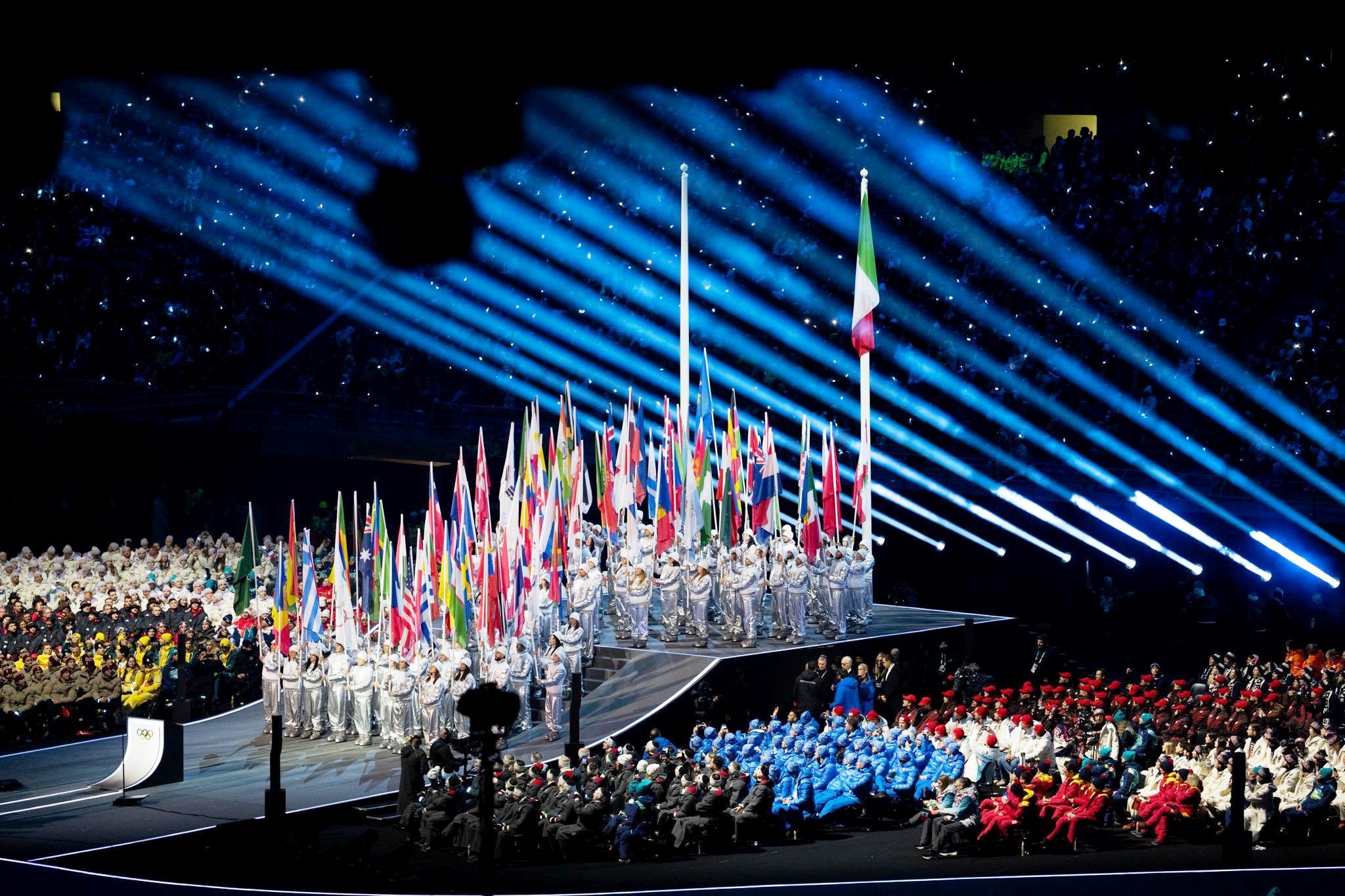
IMAGEM MERAMENTE ILUSTRATIVA. Porta-bandeiras na cerimônia de abertura dos Jogos Olímpicos de Milano-Cortina 2026. Por: Vice President JD Vance, Public domain, via Wikimedia Commons
Publicado
Cómo citar / Vancouver
Número
Sección
Licencia
Derechos de autor 2026 Gustavo Lopes dos Santos, Rosário Macário, Marie Delaplace, Stefano Di Vita

Esta obra está bajo una licencia internacional Creative Commons Atribución 4.0.